Keratoconus Treatment in Toronto – Corneal Cross Linking
What is Keratoconus?
Keratoconus is a disease of the cornea, the clear outer layer of the eye. Usually the cornea is round and dome-shaped but in some people the cornea progressively thins and develops a cone-like bulge which can make it difficult to see. Normal eye pressure pushing outward creates a cone-shaped protrusion that can affect vision and make everyday tasks like driving, watching TV or reading difficult. The condition progresses at varying rates over time. The Bochner Eye Institute was among the first practices in Canada to introduce corneal collagen cross-linking with riboflavin for keratoconus treatment. If you are having problems with your vision please set up a free consultation with our Toronto office today!
More About Keratoconus
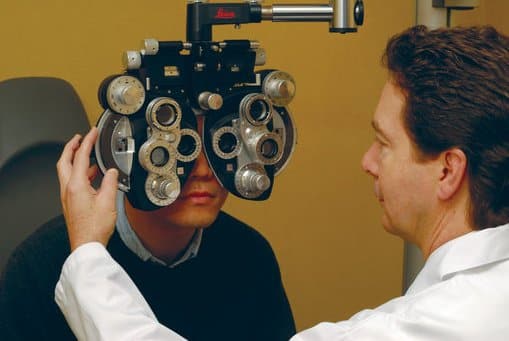
How can the Bochner Institute help with keratoconus? We established the first keratoconus clinic in Canada in 2008 and use the latest technology to help patients restore lost vision. Treatment starts with detailed diagnostic imaging that measures more than 20,000 data points of the cornea. Main Goals of Bochner Keratoconus Clinic. First, a diagnosis of keratoconus is confirmed using Pentacam and ORA imaging. Next, repeat imaging determines the rate of progress or stability of the disease. Finally, a number of therapeutic and refractive solutions can be discussed including contact lenses, corneal crosslinking, topographically-guided PRK, intrastromal corneal rings and phakic implants. Collagen Cross-Linking with Riboflavin and UV-A Light Over time, a treatment known as corneal cross-linking (CXL) has emerged as the standard of care in keratoconus. The Bochner Eye Institute was the first clinic to introduce the treatment in Canada and our physicians are widely acknowledged as the most experienced in North America. Prior to CXL, 10% of keratoconus patients required a full corneal transplant. Collagen cross-linking is used to stiffen and stabilize the corneas. First, riboflavin eye drops are applied and once absorbed by the cornea, UV-A light used for approximately 10 minutes. The treatment is very safe and has a success rate of 98% in stabilizing corneas. Benefits of Corneal Collagen Cross-Linking- Enhances corneal rigidity.
- Prevents disease progression.
- Can defer the need for corneal transplant.
- Can reduce nearsightedness and astigmatism associated with Keratoconus.
- Enhances contact lens wear.
Watch A Short Video On Keratoconus
In this short video, Dr. Raymond Stein discusses the cause, symptoms, variations and treatment of keratoconus.

The Bochner Eye Institute is the Preferred Laser And Eye Centre For The Toronto Maple Leafs™.
The Bochner Eye Institute is the Official Laser And Eye Centre OF The Toronto Blue Jays™.

Keratoconus FAQ
Who is a candidate for CXL?
Candidates for CXL include:- Keratoconus patients between 10 and 45 years of age with or without evidence of progressive disease. Earlier treatment of the disease results in best-uncorrected and best-corrected vision.
- Keratoconus patients over 25 years of age with a history of progression. This may be determined by steeping on topography, an increase in myopia or astigmatism, or a decrease in best-corrected spectacle acuity. Toronto keratoconus patients with corneas less than 320 microns, or those who have significant corneal scarring may not be eligible for the procedure. During a comprehensive consultation, the physicians at Bochner Eye Institute can help you decide which treatment is best for you.